

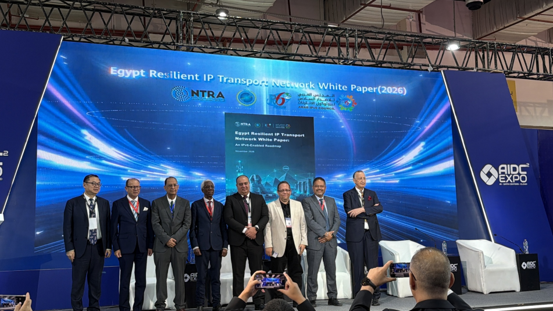
Cairo, Egypt – Against the backdrop of the 30th Cairo International Technology Exhibition and Conference (CAIRO ICT), the summit themed “Powering Egypt’s Digital Future: IPv6-Enabled Resilient Networks for the AI Era” was successfully held in Cairo, bringing together government leaders, regulators, international organizations, telecom operators and industry partners to explore the future of Egypt’s digital infrastructure.
Jointly organized by Egypt’s National Telecommunications Regulatory Authority (NTRA), the Arab ICT Organization (AICTO), the IPv6 Forum and the Arab IPv6 Council, the summit highlighted the growing importance of network resilience as artificial intelligence, cloud computing and digital transformation accelerate across industries. A major highlight of the event was the official launch of the Egypt Resilient IP Transport Network White Paper, providing strategic and technical guidance for the evolution of Egypt’s IP transport infrastructure.
Official launch of the Egypt Resilient IP Transport Network White Paper
Strengthening Egypt’s National Vision for Resilient Networks
In his opening remarks, Hossam Abdelmoula, Vice president of NTRA, highlighted the importance of building secure, intelligent and resilient networks to support Egypt’s digital future. Following the launch of Egypt’s National IPv6 Strategy in 2025, the country is taking further steps toward next-generation digital infrastructure capable of supporting the increasing demands of AI applications and critical digital services.
Mohamed Ben Amor, Secretary General of AICTO, highlighted the importance of IPv6 in advancing the Arab region’s digital transformation. He commended Egypt’s progress in IPv6 deployment and emphasized the value of regional cooperation in building secure, intelligent and resilient digital infrastructure.
White Paper Provides a Roadmap for Egypt’s Resilient IP Transport Network
A major highlight of the summit was the official launch of the Egypt Resilient IP Transport Network White Paper. Demonstrating strong cross-industry commitment to advancing Egypt’s resilient network infrastructure, the launch brought together executive representatives from NTRA, AICTO, the IPv6 Forum, WBBA, Telecom Egypt (WE), Vodafone Egypt, E& Egypt, Orange Egypt.
The discussion also highlighted the importance of sustained cooperation among regulators and operators in strengthening national network resilience. NTRA shared its ongoing efforts to establish a supportive regulatory framework and enhance coordination among government authorities and industry stakeholders, while also announcing a joint initiative with the Ministry of Communications and Information Technology to promote child online protection and safer internet access. Together, these efforts reflect Egypt’s broader commitment to building a secure, reliable and resilient digital environment to support its digital transformation.
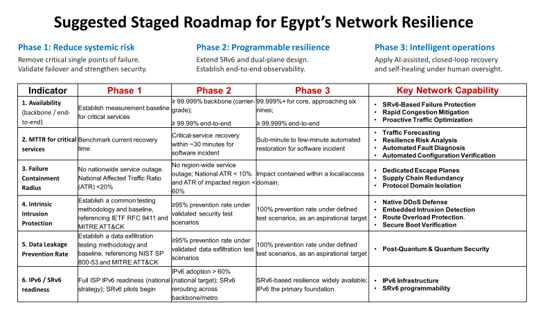
Suggested Staged Roadmap for Egypt’s Network Resilience
The white paper provides a comprehensive assessment of global IPv6 and network resilience trends, Egypt’s national development strategy, key challenges facing IP transport networks, and the technologies and reference architectures required to build resilient infrastructure.
It proposes a three-phase roadmap for Egypt’s IP network evolution: Reduce Systemic Risk, Programmable Resilience, and Intelligent Operations, supported by a measurable network resilience framework. It identifies three key priorities for future network development: Failure Containment, to prevent localized incidents from escalating into widespread service disruptions; Intrinsic Security, to strengthen built-in protection against cyber threats and data leakage; and Network Autonomy, to enable AI-driven monitoring, automated recovery and self-healing. Through the progressive adoption of technologies such as SRv6, dual-plane architectures and AI-assisted operations, the roadmap provides a practical path toward more secure, intelligent and resilient IP infrastructure.
Industry Leaders Call for Intelligent, Secure and Resilient Networks in the AI Era
Building on the strategic roadmap outlined in the white paper, industry experts shared their perspectives on global IPv6 developments, emerging network technologies and practical approaches to strengthening network capabilities in the AI era.
Latif Ladid, President and Founder of the IPv6 Forum, highlighted IPv6 and Segment Routing over IPv6 (SRv6) as fundamental enablers of network intelligence and resilience in the AI era. Building on this vision, Dr. Tayeb Ben Meriem, Chair of WBBA WG Network Technology, outlined a comprehensive approach to broadband network resilience based on four capabilities: Anticipate, Withstand, Recover and Adapt. This framework encompasses proactive traffic forecasting and risk analysis, robust security and protection mechanisms, rapid fault recovery, and continuous network optimization.
From a technology perspective, Li Haifeng, President of Carrier IP Marketing & Solution Sales Department at Huawei, emphasized the importance of intrinsic security and resilient IP architectures. As AI amplifies cyber threats and increases traffic unpredictability, he noted that more robust infrastructure is essential to ensuring continuous service availability and achieving a “zero-outage” vision.

Panel discussion of AICTO, NTRA, Telecom Egypt, Vodafone Egypt and E& Egypt
These industry perspectives were further reflected in the practical experiences shared by operators during a panel discussion featuring representatives from AICTO, NTRA, Telecom Egypt, Vodafone Egypt and e& Egypt.
Telecom Egypt highlighted its deployment of multi-vendor technologies, multiple routes and distributed network infrastructure across core, distribution and edge layers. It also shared its ongoing efforts to leverage historical and real-time network data, together with AI, to advance predictive maintenance, capacity forecasting, automated operations and self-healing capabilities. Vodafone Egypt emphasized the importance of establishing a common national vision for digital infrastructure and strengthening network redundancy to eliminate single points of failure. It also highlighted the value of industry forums and closer cooperation among operators in sharing experience and advancing practical approaches to network resilience. E& Egypt highlighted the potential of AI-driven network intelligence to support risk prediction, automated responses and the development of autonomous networks, with an ambition to reach Level 4 autonomy before 2030. It also stressed that network resilience requires physically diverse fiber routes, not merely logical network separation, and called for the development of regional fiber rings in areas such as the Nile Delta and Sinai to strengthen the resilience of Egypt’s national infrastructure.
The discussion also highlighted the importance of sustained cooperation among regulators and operators in strengthening national network resilience. NTRA shared its ongoing efforts to establish a supportive regulatory framework and enhance coordination among government authorities and industry stakeholders, while also announcing a joint initiative with the Ministry of Communications and Information Technology to promote child online protection and safer internet access. Together, these efforts reflect Egypt’s broader commitment to building a secure, reliable and resilient digital environment to support its digital transformation.
Read More about the National IP Transport Network White Paper