

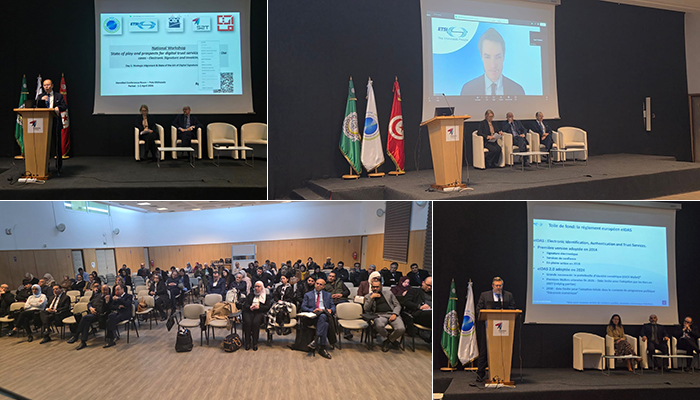

Closing of the Strategic Workshop on State of Play and Prospects for Digital Trust Services in Tunisia: Use Cases – e-signature and e-Invoicing 01–02 April 2026 – El Ghazala Technopark, Tunis
As part of the implementation of the Arab ICT Organization Technologies (AICTO) programme aimed at strengthening the capacities of Arab countries in the field of digital trust services, particularly through the Arab Network of Certification Authorities project, AICTO, in cooperation with the Ministry of Communication Technologies of the Republic of Tunisia and the European Telecommunications Standards Institute (ETSI), organized a strategic workshop entitled: “ State of Play and Prospects of Digital Trust Services in Tunisia: Use Cases – eSignature and eInvoicing”, held on 01 and 02 April 2026 at the conference hall of El Ghazala Technopark.
The workshop witnessed active participation from representatives of relevant Tunisian ministries, public authorities, and private sector companies, in addition to regional delegations from Egypt’s Information Technology Industry Development Agency (ITIDA) and the General Authority for Communications and Informatics of the State of Libya.
This workshop falls within ongoing efforts to support digital transformation and lay the foundations of a digital economy through the development of an integrated ecosystem for digital trust services that meets national requirements and aligns with relevant regional and international trends.
In his opening remarks, H.E. Eng. Mohamed Ben Amor, Director General of AICTO, emphasized that digital trust services—particularly electronic signatures and e-Invoicing constitute a fundamental pillar for building a secure and trusted digital economy in Tunisia and across the Arab region. He further highlighted that this workshop is part of a regional initiative led by AICTO, in collaboration with national and international partners, aimed at harmonizing legislation and standards and achieving mutual recognition of electronic documents among Arab countries.
He also noted that AICTO is currently working on establishing a regional core involving Tunisia, Libya, and Egypt, with plans to expand it to include other interested Arab countries, thereby facilitating intra-Arab e-commerce and strengthening regional digital economic integration.
For his part, Mr. Martin Chatel, Senior Policy Officer at ETSI, delivered a keynote address focusing on digital signatures and e-Invoicing, highlighting the importance of standards and interoperability in building a reliable and efficient digital ecosystem.
Mr. Xavier Piednoir, Director of International Projects at ETSI, also presented the leading role of the ETSI TC ESI committee in supporting trusted digital ecosystems and addressing the requirements of eIDAS 2 and the European Digital Identity Wallet (EUDI Wallet). This occasion provided an excellent opportunity to present the GIST project and to highlight the leadership role of the ETSI International Projects team.
Throughout the workshop, discussions were structured across several specialized sessions addressing the various dimensions of digital trust services. The first session focused on the latest international frameworks and standards related to electronic signatures and e-Invoicing, with particular emphasis on European references, notably the eIDAS framework, signature standards, and eInvoicing formats, as well as progress achieved in the Arab integration project for public key infrastructure and machine-readable trusted lists.
The second session addressed the current Tunisian framework for electronic signatures and e-Invoicing, including an analysis of technical and regulatory gaps compared to international standards and practices. It also covered legal aspects, remote signing, identity verification, long-term validation mechanisms, and time-stamping. The session further included a presentation of the Egyptian experience in the field of e-Signature and e-Invoicing.
The third session provided a platform for digital trust service providers to share their experiences, addressing practical challenges related to the large-scale deployment of e-signature and e-Invoicing services, particularly in terms of performance, interoperability, economic feasibility for businesses, and user experience in managing digital certificates.
On the second day, the fourth session was dedicated to interactive workshops aimed at formulating practical recommendations and a shared roadmap, covering legal and technical aspects as well as priority use cases, particularly in the areas of digital finance and e-Government services.
This workshop constituted an important platform for exchanging expertise and discussing best practices and comparative experiences related to practical use cases of digital trust services, especially in the fields of e-Signature and e-Invoicing, thereby supporting the development of a secure, trusted, and investment-friendly digital environment.
The workshop concluded with a strong emphasis on the importance of continued coordination among all stakeholders at both national and regional levels, and on joint efforts to define concrete steps to strengthen digital trust ecosystems and enhance the readiness of Arab countries to integrate into the regional and global digital economy.


